How to vacuum the bottom of my pool? 4 simple and effective techniques
The bottom of your pool quickly accumulates sand, leaves, insects, or small debris. So how to effectively vacuum the bottom of my pool without spending hours?

Here are the 4 most used methods to clean the bottom of a pool, with their advantages and disadvantages.
Quick summary: which technique to choose?
Before going into detail, here's a simple summary:
| Technique | Efficiency | Effort | Time |
|---|---|---|---|
| Manual brush | Good | High | Long |
| Pool robot | Very high | Very low | Quick |
| Waste mode | Very high | Medium | Quick |
| Venturi vacuum | Medium | Medium | Medium |
In short:
- Small budget? → Manual brush
- Zero effort? → Pool robot
- Very dirty pool? → Waste mode
- Small pool / spa? → Venturi
1. Vacuuming with a manual brush (classic method)

This is the most well-known technique.
You need:
- a vacuum brush
- a telescopic pole
- a floating hose
- connect to the skimmer
How to do it:
- Connect the brush to the skimmer.
- Slowly move it across the bottom of the pool.
- Focus on dirty areas.
Advantages:
✅ economical
✅ precise
✅ effective for small pools
Disadvantages:
❌ long
❌ requires effort
❌ depends on filtration
2. Using a pool robot (the simplest solution)

Today, this is clearly the most practical solution.
An autonomous robot vacuums directly:
- sand
- dust
- leaves
- insects
Effortlessly.
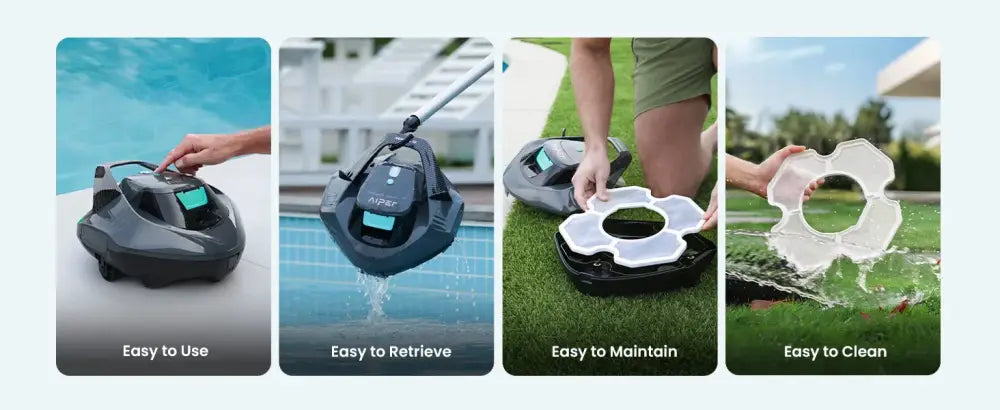
The Aiper Seagull SE is designed for flat-bottomed pools up to 80m², with 90 minutes of battery life and a maximum depth of 3 meters. Its filter is easily removable for cleaning.
How it works:
- Full charge (approx. 2.5 hours)
- Launch into water
- It starts automatically after reaching the bottom
- It stops automatically against the wall when the battery is low
Advantages:
✅ zero effort
✅ autonomous cleaning
✅ cordless
✅ ideal for regular maintenance
3. Vacuuming in "waste" mode (for heavy deposits)

Very effective after:
- storm
- sand
- green water
- heavy deposits
The principle:
instead of sending water to the filter, it goes directly to the sewer.
Why:
The filter does not get clogged.
Disadvantage:
❌ significant water loss
4. Using a Venturi vacuum cleaner

Good alternative without electricity.
Works with a garden hose:
the pressure creates suction.
Ideal for:
- small pools
- spa
- small areas
Limitations:
❌ less powerful
❌ less precise on fine sand
What is the best method for vacuuming the bottom of a pool?
It all depends on your situation:
- for occasional maintenance → manual brush
- for quick effortless cleaning → pool robot
- for a very dirty bottom → waste mode
- for a spa or small pool → Venturi
If you are looking for the simplest solution to vacuum the bottom of your pool effortlessly, the robot remains the most effective method today.
The Aiper Seagull SE allows you to start a complete autonomous cleaning, without complicated hoses or connections.